

By David Koch, CFP®, AIF®, CEPA® ,CFA, Director of Portfolio Management/Senior Wealth Advisor
Why Is Copper Called ‘Dr. Copper’?
The term “Dr. Copper” has been used widely in economics because copper price movements can serve as a “health check” for economic trends. Unlike gold, copper has a wide variety of industrial uses. Only about 10% of the global gold supply is used on an industrial scale compared to about 70% of copper. Copper is also an important metal in the global economy due to its unique physical and chemical properties, which make it essential across a wide range of industries. Known for its excellent electrical and thermal conductivity, ranking second behind silver, copper is the preferred material for electrical wiring in homes, buildings, infrastructure, and electronics such as circuit boards, smartphones, and computers
In addition, copper plays a critical role in power generation and transmission, including components like transformers, motors, and generators, and in heat exchangers like air conditioning and refrigeration systems. In addition, it is widely used in construction for plumbing, roofing and cladding systems, and important in machinery and industrial equipment for making alloys like bronze and brass.
Copper Prices Rise After Surprise U.S. Tariff Announcement
Earlier this month, global markets were rocked by a dramatic shift in U.S. trade policy and its immediate impact on copper prices. President Trump announced a sweeping 50% tariff on copper imports, a move that has sent shockwaves through commodity markets and reignited debates over protectionism and global supply chains.
The announcement, made during a Cabinet meeting, was framed as a national security measure. The administration argued that overreliance on foreign copper – particularly from Chile, Canada, and Mexico – posed a strategic risk to the United States. The U.S. currently imports over half of its refined copper, with Chile alone accounting for nearly 40% of that total. The tariffs are expected to take effect by the end of July or August 1, 2025.
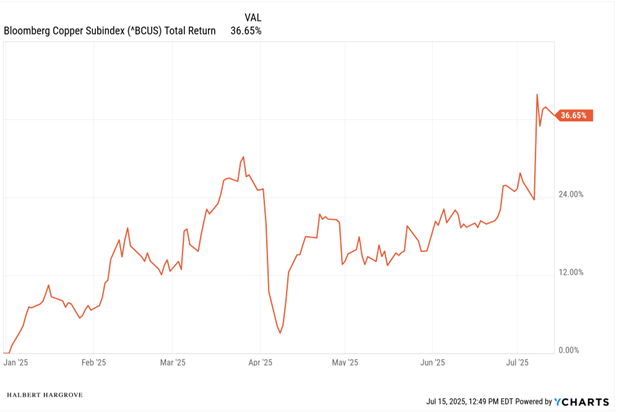
The market’s reaction was swift and dramatic, and on July 8th, copper surged 13% in a single day. Several factors contributed to the intensity of this price movement. First, the market had anticipated a lower tariff rate, so the 50% figure came as a surprise. Second, traders rushed to secure copper supplies before the tariffs took effect, creating a surge in demand. As of July 14th, the price of copper has risen almost 38% in 2025.
Mixed Outlook on U.S. Copper Tariffs
Analysts are divided on the long-term implications. Some, like those at Morgan Stanley, believe the price surge may be temporary, as domestic inventories adjust and the market stabilizes. How temporary is unknown. Other arguments suggest that the tariffs could lead to sustained higher prices, especially if global supply chains are disrupted or if other countries retaliate with their own trade barriers
The geopolitical implications are also significant. Chile, the world’s largest copper producer, has expressed concern over the lack of communication from the U.S. government. Maximo Pacheco, chairman of Chile’s state-run miner Codelco, noted that it remains unclear which copper products will be affected, as the U.S. announcement referred to copper in general terms.
Domestically, the tariffs are expected to benefit U.S. copper producers in the short term, potentially revitalizing a sector that saw a 3% decline in output in 2024. However, downstream industries that rely on copper, such as construction, electronics, and renewable energy, may face higher input costs, which could ripple through the broader economy.
July’s Copper Tariffs Underscore Uncertainty in Global Trade
The intersection of tariffs and copper prices in July 2025 highlights the complex dynamics of global trade and commodity markets. While the immediate effect has been a sharp rise in copper prices, the long-term consequences will depend on how markets, governments, and industries adapt to this new trade environment.
If “Dr. Copper” could talk, he might opine, “At this point, it’s too early to determine how serious it is. We’ll monitor it closely and follow up with additional diagnostics.”
References:
Here’s Why Copper Prices Hit A Record High – Forbes
Copper Soars After Trump Unveils Tariff Plan – Money Metals Exchange
Copper use U.S. by purpose 2023| Statista
Innovations: Introduction to Copper: Applications
Disclosures:
Halbert Hargrove Global Advisors, LLC (“HH”) is an SEC registered investment adviser with its principal place of business in Long Beach, California. HH may only transact business in those states in which it is registered, notice filed, or qualifies for an exemption or exclusion from registration or notice filing requirements. Registration does not imply a certain level of skill or training. For information pertaining to the registration status of HH, please contact HH or refer to the Investment Adviser Public Disclosure web site (www.adviserinfo.sec.gov). Additional information about HH, including our registration status, fees, and services can be found at hhgastg.wpengine.com.
This blog is provided for general information purposes only. No portion of the content serves as the receipt of, or as a substitute for, personalized investment advice from HH or any other investment professional of your choosing. It should not be construed as a solicitation to offer personal securities transactions or provide personalized investment advice. The information provided does not constitute any legal, tax or accounting advice. We recommend that you seek the advice of a qualified attorney and accountant.
Different types of investments involve varying degrees of risk, and it should not be assumed that future performance of any specific investment or investment strategy, or any non-investment related or planning services, discussion or content, will be profitable, be suitable for your portfolio or individual situation, or prove successful. The views contained herein are not to be taken as advice or a recommendation to buy or sell any investment. Any forecasts, figures, opinions or investment techniques and strategies set out are for information purposes only, based on certain assumptions and current market conditions and are subject to change without previous notice. There is no guarantee any forward-looking statement will come to pass. All opinions or views reflect the judgment of the author as of the publication date and are subject to change without notice. All information presented herein is considered to be accurate at the time of writing, but no warranty of accuracy is given and no liability in respect of any error or omission is accepted. This material should not be relied upon by you in evaluating the merits of investing in any securities or products mentioned herein. In addition, the Investor should make an independent assessment of the legal, regulatory, tax, credit, and accounting and determine, together with their own professional advisers if any of the investments mentioned herein are suitable to their personal goals. Investors should ensure that they obtain all available relevant information before making any investment. It should be noted that the value of investments and the income from them may fluctuate in accordance with market conditions and taxation agreements and investors may not get back the full amount invested. Both past performance and yield may not be a reliable guide to future performance. Any reference to a market index is included for illustrative purposes only as it is not possible to directly invest in an index.