By JC Abusaid, AIF®, CEO/President, Halbert Hargrove
Key Takeaways
- Longevity is reshaping financial planning. Longer lifespans require planning that goes beyond retirement savings to include health, caregiving, and quality of life.
- Advisors must expand the client conversation. Addressing topics like health span, family dynamics, and emotional well-being helps create stronger, more meaningful client relationships.
- AI and new tools are essential to keep pace. Advisors who adopt AI and build longevity-focused toolkits can deliver more holistic, future-ready guidance.
Rethinking Financial Planning for a Longer Life
What financial decisions would you make if you knew you had an additional 30 years to live?
For most of human history, the average life expectancy was around 30 to 40 years. In the past century, though, life expectancy has increased by decades, especially for the Silent Generation and Baby Boomers.
Even so, many people do not fully understand what this “gift” of longevity means or how it will impact future generations.
This was the focus of a recent Stanford Center on Longevity Initiative: The New Map of Life conference, where I moderated a panel titled, “Financial Advice in an Age of Longevity.” We discussed practical tools advisors can use now to offer longevity-related services and help build stronger client relationships.
While we don’t know what’s to come, one thing is for certain: it’s hard to predict how long future generations will live or what changes lie ahead. With rapid advances in technology, medicine, and now AI, could Millennials and Gen X potentially reach average ages of 90 or even 100? This question has big implications for financial planning.
Here are some ways advisors can help make a difference.
We must match health spans with longer life spans
People are starting to realize how important it is to take care of their health, and we now have access to more data than ever. We need to make sure our years of good health keep up with our longer lifespans. Many in the sandwich generation—those caring for both aging parents and children—face tough choices about where to live, how to find reliable caregivers, and which financial decisions will support their family’s health, such as home improvements or hiring specialists to spot chronic diseases early. Because of this, there’s a growing movement to rethink longevity planning, focusing on proactive, family-centered advice.
Advisors must reframe the client conversation around longevity
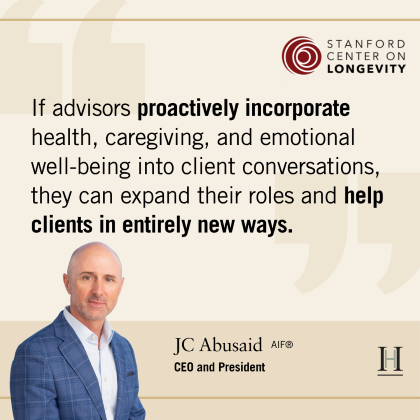
Still, many financial advisors lack the training and skills needed for longevity planning, so they often stick to traditional asset management. Clients care about health, caregiving, and emotional well-being, but these topics rarely come up in meetings. This gap is both a challenge and an opportunity. If advisors proactively incorporate these issues into client conversations, they can expand their roles and help clients in new ways.
Financial advisors must embrace AI
AI experts were present, and, as is typical with AI-related conversations, perspectives ranged from cautious to optimistic about its impact on the workforce. My conclusion is that AI will enhance our work. Thus, we have no choice but to engage strategically with AI and incorporate it into our business alongside the right policies, business collaborations, and educational structures.
We must create a longevity toolkit for financial planning
It won’t be easy for RIAs to build these new skills outright, so it’s essential to align with longevity experts and offerings and build a toolkit that matches your firm’s ethos. Fortunately, there is a growing range of options available.
- The Stanford Center on Longevity (SCL) is completing its Foundations of Longevity course and is exploring custom modules for wealth managers.
- Place Planning uses a research-based, holistic approach to help families find the best place to live at every stage of life. This can help bring more joy, peace of mind, and fulfillment.
- InvestInU Online Academy offers a longevity planning course designed to help advisors have better conversations with their clients about longevity.
- And, at Halbert Hargrove, bQuest has helped us connect with important providers we couldn’t reach before. This includes a care coordination platform that offers connection to providers for in-home care, end-of-life support, and other services.
Take the First Step Toward Longevity-Focused Financial Planning
Leveraging any of these tools is a positive step that can add value and help build stronger, more meaningful client relationships. If your firm is unsure about how to start this, I encourage you to take intentional first steps now to integrate longevity into your planning approach.
One practical way to do this is by learning from those who are already leading this shift. I recommend reading Optimizing Longevity: A Road Atlas for a Happier, Less Predictable Life, by my colleague and Halbert Hargrove’s Executive Chairman, Russ Hill.
This book provides a practical roadmap for advisors who want to lead more meaningful client conversations and stay ahead of a rapidly evolving financial planning landscape.
Halbert Hargrove Global Advisors, LLC (“HH”) is an SEC registered investment adviser with its principal place of business in Long Beach, California. HH may only transact business in those states in which it is registered, notice filed, or qualifies for an exemption or exclusion from registration or notice filing requirements. Registration does not imply a certain level of skill or training. For information pertaining to the registration status of HH, please contact HH or refer to the Investment Adviser Public Disclosure web site (www.adviserinfo.sec.gov). Additional information about HH, including our registration status, fees, and services can be found at www.halberthargrove.com.
This blog is provided for general information purposes only. No portion of the content serves as the receipt of, or as a substitute for, personalized investment advice from HH or any other investment professional of your choosing. It should not be construed as a solicitation to offer personal securities transactions or provide personalized investment advice. Different types of investments involve varying degrees of risk, and it should not be assumed that future performance of any specific investment or investment strategy, or any non-investment related or planning services, discussion or content, will be profitable, be suitable for your portfolio or individual situation, or prove successful. Neither HH’s investment adviser registration status, nor any amount of prior experience or success, should be construed that a certain level of results or satisfaction will be achieved if HH is engaged, or continues to be engaged, to provide investment advisory services. HH is neither a law firm nor accounting firm, nor does it serve as an attorney, accountant, or insurance agent. No portion of its services, or this content, should be construed as legal or accounting advice. HH does not prepare legal documents or tax returns, nor does it sell insurance products. No portion of the content should be construed by a client or prospective client as a guarantee that he/she will experience a certain level of results if HH is engaged, or continues to be engaged, to provide investment advisory services. All opinions or views reflect the judgment of the author as of the publication date and are subject to change without notice. All information presented herein is considered to be accurate at the time of writing, but no warranty of accuracy is given and no liability in respect of any error or omission is accepted.