By David Bodamer, Wealth Management, featuring David Koch, CFP®, AIF®, CEPA®, CFA, Director of Portfolio Management/Senior Wealth Advisor
How U.S. actions in Venezuela, threats to the Fed’s independence and proposals on capping credit card interest rates and institutional homeownership are affecting allocation decisions.
Chief investment officers and investment committees in the wealth management space stress the importance of setting up client portfolios for the long-term and avoid overreacting to short-term market disruptions. In addition, aside from a brief, sharp sell-off in response to the tariffs imposed on Liberation Day last spring, markets themselves have become less responsive to policy and geopolitical shocks, including sending gold and silver to new all-time highs.
However, recent events have prompted a new bout of volatility. The revelations of an investigation into Federal Reserve Chairman Jerome Powell renewed concerns about long-term Fed independence. Regime change in Venezuela, unrest in Iran and uncertainty about Russia’s war on Ukraine have been shocks on the geopolitical front. And recent proclamations from President Donald Trump about capping credit card interest rates and limiting institutional ownership of homes have investment implications.
With all of that afoot, Wealth Management reached out to wealth management firms to gauge CIO and investment committee reactions and whether they had any plans to adjust asset allocation recommendations as a result.
While views vary, some common themes stand out.
From a macro perspective, investment strategists expect continued economic growth and believe the Fed will retain its independence and continue its path of gradual easing. They expect strong earnings growth, driven by strong fundamentals. However, there are some concerns about elevated valuations for the equities market in addition to the overall market concentration with a handful of megafirms dominating indexes.
Firms are doubling down on the importance of diversification across all asset classes to manage volatility and concentration risks. Some are pointing to private markets to help with diversification and seek out alpha. They recommend broad exposures to corporate bonds, municipal bonds, mortgages and asset-backed securities within fixed-income allocation.
In addition, investment pros remain bullish on artificial intelligence and technology, precious metals and other commodities and international exposures to serve as a currency hedge and access to diversification and growth opportunities.
The following slideshow includes the views of more than a dozen experts on the current state of markets.
David Koch, Director of Portfolio Management and Senior Wealth Advisor, Halbert Hargrove
While we have a grasp of the “known unknowns,” like normal market volatility and interest rate changes, and how those tend to impact portfolios, we’re seeing more risks in the “unknown unknowns” territory.
Geopolitical tensions are rising, for example. Ukraine is entering its fourth year of conflict. There has been a regime change in Venezuela and now potentially Iran. Looking further out at the general trend of unwinding the global order, we just don’t know how that is going to pan out.
Domestically, we have uncertainty of how AI is going to shift the workplace, and we also have real threats against the Fed’s independence, and while the Chair only has one vote, they are the figurehead and spokesperson. We may see more divergence in voting among the members of the FOMC as a result.
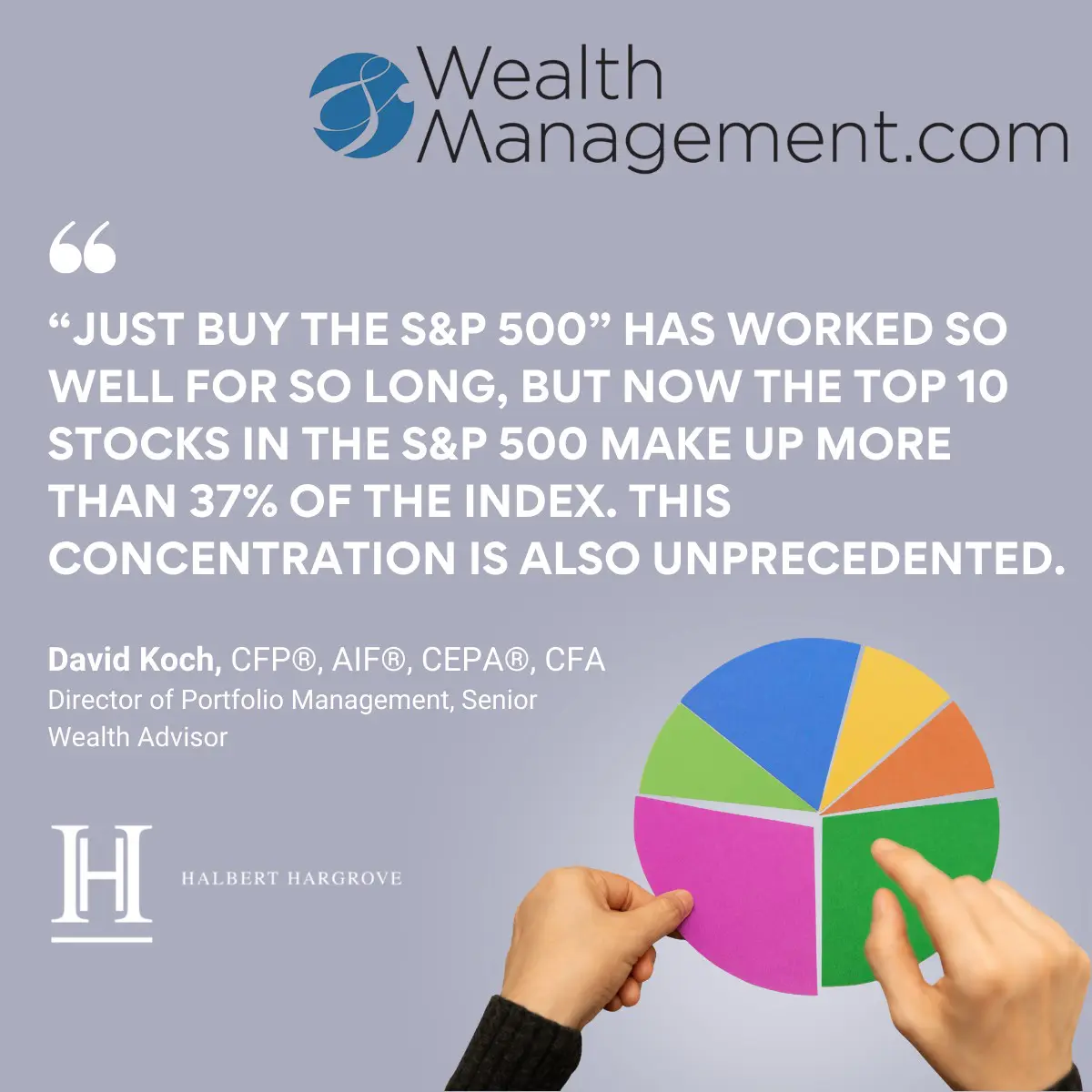
Faced with unknown unknowns, diversification is likely more important in today’s environment than it has been in the last 25 years. “Just buy the S&P 500” has worked so well for so long, but now the top 10 stocks in the S&P 500 make up more than 37% of the index. This concentration is also unprecedented.
In the growth part of your portfolio, maintaining an international developed and emerging markets allocation in equities can help diversify the concentration in U.S. large cap, as can having an allocation to small and microcap. Private equity is also a market that may provide some additional diversification.
Staying broadly diversified, and active, in fixed income is likely going to be more important than before. This means owning not just core corporate and muni bonds, but mortgages and asset-backed securities. The private credit markets are the only way you can access some of these markets and should also play a role in helping diversify your fixed income.
Alternatives should also play an important role in portfolios that should also help manage unknown unknown volatility. This means not just real estate, but reinsurance, and even Bitcoin may help dampen volatility at the portfolio level without reducing your expected total return the way simply adding more core bonds would.
Lastly, it is important to have proper trading policies and strategies in place ahead of time. A 60/40 SPY/AGG portfolio in January 2023 would have drifted into a 70/30 portfolio without rebalancing, so maintaining risk controls and tactically playing offense with equity volatility can also play an important role.