Key Takeaways
- Market leadership can change quickly. The first half of 2026 demonstrated how rapidly market performance can shift, reinforcing the importance of maintaining a long-term investment perspective.
- Diversification remains a core investment principle. Broad exposure across asset classes and regions can help investors navigate changing market environments.
- Long-term discipline matters more than market headlines. While news cycles and economic uncertainty can influence investor sentiment, maintaining focus on long-term goals and portfolio fundamentals is essential.
Why Long-Term Investing Still Matters
Market volatility can make it tempting to react to the latest headlines. Economic data, geopolitical events, and changing investor sentiment often influence the news cycle, making it feel as though every development requires immediate action.
Periods of uncertainty often reinforce some of the most enduring principles of investing. The first half of 2026 demonstrated how quickly market leadership can shift, how broad participation can return, and why maintaining a disciplined investment approach may be more valuable than trying to predict short-term market movements.
Market Leadership Doesn’t Stay the Same
One of the defining characteristics of the first half of 2026 was how quickly market leadership shifted.
Following a challenging start to the year, markets recovered as investor confidence improved and participation broadened beyond a relatively small group of large technology companies. Returns expanded across additional sectors and regions, demonstrating that market leadership can change quickly.
This serves as an important reminder that market leadership rarely remains constant. Asset classes, industries, and geographic regions often move through different periods of strength and weakness. Investors who concentrate too heavily in one area may benefit during periods of outperformance but can also become more vulnerable when market leadership changes.
Diversification Is Designed for Changing Markets
Diversification remains one of the most effective ways to navigate changing market environments. Rather than relying on a single investment, sector, or geographic region, diversified portfolios are designed to spread risk across multiple asset classes. This approach recognizes that no one area can consistently lead the market every year.
As such, it’s vital to maintain exposure across U.S. equities, international markets, fixed income, and other investment categories rather than making significant allocation changes based on recent performance alone.
While diversification cannot eliminate investment risk, it can help create a portfolio that is better positioned to adapt as market conditions evolve.
Looking Beyond Market Headlines
Headlines often highlight significant market moves, but they may not always provide a comprehensive view.
Daily news coverage may emphasize economic uncertainty, inflation, interest rates, or geopolitical developments. While these factors certainly influence markets, investors can also benefit from paying attention to longer-term fundamentals such as corporate earnings, valuations, and overall economic trends.
Market concentration has become an important consideration in recent years. When a relatively small number of companies account for a significant portion of market returns, it can create additional risks if leadership begins to shift.
Looking beyond headlines allows investors to evaluate how these broader trends fit within a long-term investment strategy rather than reacting to individual news events.
Volatility Is a Normal Part of Investing
Periods of market volatility can feel uncomfortable, but they are not unusual.
Throughout market history, corrections and periods of uncertainty have occurred regularly. While no two market cycles are identical, volatility has consistently been part of long-term investing.
Rather than attempting to predict every market movement, successful investing often depends on maintaining a disciplined process during both strong and weak markets. Emotional decisions driven by short-term market swings can make it more difficult to stay aligned with long-term financial goals.
Understanding that volatility is expected, not exceptional, can help investors maintain perspective when markets become unpredictable.
International Markets Continue to Add Diversification
International markets can provide an additional source of diversification. Differences in valuations, earnings expectations, and economic conditions create opportunities that may complement U.S. investments and help reduce concentration risk over time.
While U.S. markets have received significant attention in recent years, international equities have experienced periods of renewed strength. The discussion highlighted differences in valuations, earnings expectations, and market composition that can create opportunities for diversification outside the United States.
Maintaining global exposure can help reduce concentration risk while providing access to different economic cycles and sources of growth.
Fixed Income and Alternatives Continue to Evolve
Fixed income continues to play an important role in portfolio construction as interest rates and economic conditions evolve. Higher yields, credit quality, and portfolio objectives all influence how bonds fit within a broader investment strategy. Alternative investments may also complement traditional asset classes when they align with an investor’s goals and risk tolerance.
Today’s bond market differs from previous years, including the relationship between yields, credit quality, and portfolio construction. It also touched on the role alternative investments may play within a diversified portfolio, depending on an investor’s objectives and overall financial strategy.
Rather than viewing these investments in isolation, they are most effective when considered as part of an overall portfolio designed around an individual’s goals and risk tolerance.
Staying Focused on Long-Term Goals
Markets will continue to respond to changing economic conditions, policy decisions, and global events. While it’s impossible to predict every short-term movement, investors can control how they respond.
Maintaining a diversified portfolio, evaluating investments through a long-term lens, and avoiding decisions driven by short-term uncertainty remain foundational investment principles. As the first half of 2026 demonstrated, markets can change direction quickly, making patience and discipline valuable characteristics for long-term investors.
Looking for guidance in changing markets?
Whether you’re preparing for retirement, managing generational wealth, or evaluating your current investment strategy, Halbert Hargrove can help you build a financial plan designed around your long-term goals.
Connect with a Halbert Hargrove advisor to discuss your portfolio, investment strategy, and financial future.
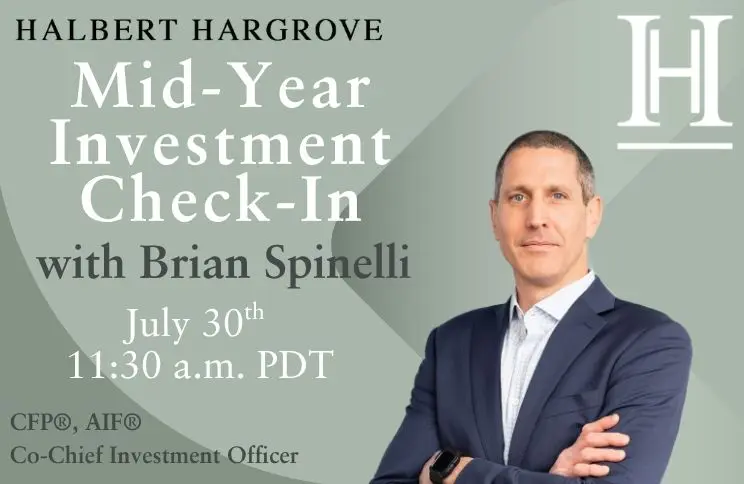
Want to learn more? Watch Brian Spinelli give a market recap here.