By Debbie Carlson in Barron’s featuring Brian Spinelli, CFP®, AIF®, Co-Chief Investment Officer
Investors may have overlooked one of 2025’s strongest market performers: emerging markets.
The MSCI Emerging Markets Index rose 34% last year, nearly double the S&P 500’s 17.8% total return. Some market observers believe the rally has just begun.
Emerging markets’ last heyday was in the early 2000s, when China’s boom, a commodities supercycle, and a weak U.S. dollar powered a decade of strong growth. Positive demographics and a story of a rising middle class and increased consumption to fuel economic expansion also raised buyers’ expectations.
The region’s demographics remain solid and the U.S. dollar is weak, but technological and manufacturing growth were the driving forces of last year’s rally, says Dina Ting, head of global index portfolio management at Franklin Templeton. China and India remain important, but countries such as Taiwan and South Korea are also big contributors to returns, she adds, with no one country dominating the group’s performance.
“The drivers of growth across each country is making it more interesting for investors,” Ting says. “That’s why diversification becomes even more important.”
Valuations in emerging markets versus the U.S. also make the region attractive, Ting says, noting that as of late 2025, emerging market equities traded at nearly a 40% discount to U.S. peers, one of their lowest forward price/earnings differentials in more than a decade.
Investors looking to put new money to work in emerging markets in 2026 should review their current international fund holdings, says Elisabeth Kashner, director of exchange-traded fund research and analytics at FactSet. The biggest international ex-U.S. funds by assets have about 20% dedicated to the sector, with most of that tilted toward Asian emerging markets.0
There’s a debate among index providers over whether South Korea belongs in the developed or emerging market category. MSCI includes South Korea, while FTSE Russell doesn’t, and the difference affects returns. Last year, the iShares Core MSCI Emerging Markets Index ETF rose 33%, while the Vanguard FTSE Emerging Markets Index ETF gained 26%.
Kashner says there are legitimate differences of opinion about what constitutes a developed economy versus an emerging one, and she recommends investors stick with one fund family when choosing such funds.
“There’s no right or wrong answer to that question, but it is really important to be consistent. If you’re not, you could potentially wind up with gaps or overlaps,” she says.
There are echoes of the late 1990s and early 2000s in today’s markets, says Mark McCarron, chief investment officer at Wescott Financial Advisory Group, and that makes it worthwhile to include emerging markets in a portfolio. He uses the iShares ETF and the Dimensional Emerging Core Equity Market ETF, an actively managed fund that seeks cheaper and higher-quality names.
Last year’s international markets’ performance generally exceeded most people’s expectations, he says, lifted by a combination of fundamental improvement and a weaker dollar. It’s a reminder that diversification from U.S. markets matters.
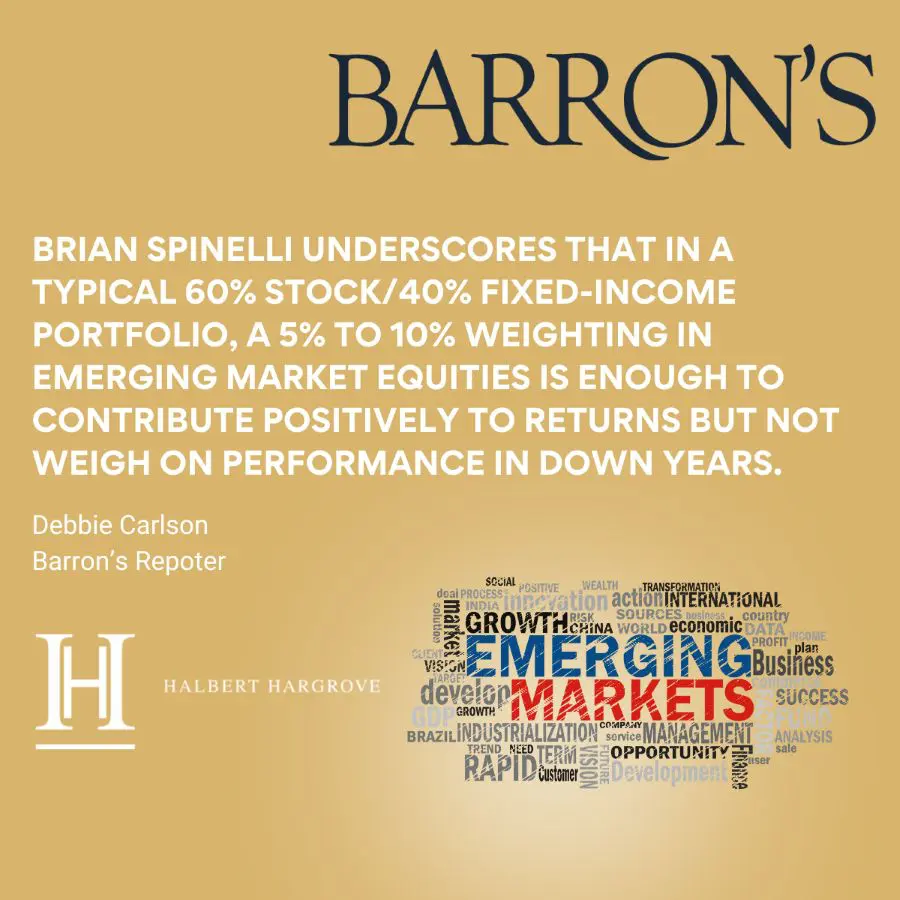
Brian Spinelli, co-chief investment officer at Halbert Hargrove, says in a typical 60% stock/40% fixed-income portfolio, a 5% to 10% weighting in emerging market equities is enough to contribute positively to returns but not weigh on performance in down years. He recommends new investors stick with broadly diversified index funds.
Ting agrees. Those who want to expand beyond a core holding and want to tilt portfolios to emphasize or underweight countries have options now, unlike during emerging markets’ last pinnacle, such as ex-China funds, single-country funds, or sector funds.
Some niche funds have shown strong outperformance, such as the Freedom 100 Emerging Markets ETF, an ex-China fund which was up 65% in 2025.
Kashner reminds investors who want to use a building-block approach to be diligent if they’re not using a core fund.
“If you’re going to stray from something like that, then you need to be really clear with yourself about why, what your goals are, and how you’re going to continue to test your hypothesis as you do product research,” she says.