
By JC Abusaid, CEO/President, featured in Forbes
Many leaders treat setting a leadership agenda as a formal process: It is introduced at the start of the year, outlined in presentations and supported by key initiatives. They often assume that once articulated, the agenda will be automatically implemented.
In my experience, that assumption is where things begin to go wrong.
I believe that a leadership agenda is not just something announced every January, but something that must be lived consistently through a firm’s culture. When behavior does not reflect stated values, those values lose meaning. Values need to be visible in leadership behavior and decisions. Over time, the alignment between leadership agendas and culture becomes evident. The absence of that can easily impact the credibility of your leadership agenda.
The data supports this idea. A 2025 Clearpoint Strategy analysis of over 20,000 strategic plans found that 84.5% of projects were never completed, and less than 6% of organizations finished three-quarters or more of their initiatives. The issue is not ambition; it’s execution.
Execution improves when leaders maintain focus, define ownership and revisit priorities instead of chasing momentum.
Key Takeaways
- Execution fails without alignment and ownership. Most leadership agendas fall short due to unclear accountability, shifting priorities, and lack of follow-through.
- Clarity and consistency drive momentum. Breaking goals into long-, mid-, and short-term priorities helps teams stay focused and aligned throughout the year.
- Leadership requires balance and adaptability. Strong leaders combine conviction with flexibility, reinforcing trust and maintaining direction through uncertainty.
Where Leadership Agendas Lose Momentum
One way agendas lose momentum is because of egos. An ego can quietly undermine good intentions, causing leaders to dismiss input too quickly.
Conversely, while collaboration matters, it can also slow progress when leaders delay decisions in pursuit of full consensus. It is important for leaders to strike the right balance between collaboration and making decisions. I have found that strong leaders listen, weigh perspectives and then decide, because when that balance is lost, momentum can fade.
Many leaders don’t realize that ownership and accountability are another common failure point, with 57% of projects in the same Clearpoint analysis lacking clear ownership. Meetings may continue, and updates may be shared, but progress slows because no one is responsible for driving results. While clear accountability does not guarantee success, it can increase the likelihood of completion.
I have also found that presenting a leadership agenda as a guarantee can hurt execution, leaving little room for market changes and unanticipated challenges. Employees value clear direction and most likely recognize that no leader has perfect foresight. I suggest communicating with conviction when speaking to your employees while simultaneously allowing room for feedback. Confidence with humility is often stronger than confidence alone.
Clarity Before Urgency
At the start of each year, it can feel as though everything is urgent and important, with every initiative appearing critical and every request competing for priority. In these moments, clarity must come first.
For many, clarity can come from setting long-term, mid-term and quarterly goals. Long-term goals set direction, and implementing mid-term milestones makes the vision more manageable, with quarterly priorities keeping focus on what matters at each point in the year. At Halbert Hargrove, we call our key initiatives for each quarter our “rocks” and then set long-term and mid-term goals to help accomplish them. By identifying these rocks in advance, we make it clear to the entire organization what actually needs to get done during that quarter.
Clarity is more important than many leaders realize. Research from Gallup shows that only 46% of employees knew what is expected of them at work in 2024. When expectations are unclear, employee engagement, productivity and profit can be negatively impacted.
Consistent measurement and review keep the agenda on track. We regularly assess what is working, where adjustments are needed, and whether our quarterly rocks still align with current needs. Based on this feedback, we may shift priorities and timelines, as alignment sometimes requires change. Before setting those priorities, we ask for input from leaders across the firm, not because every suggestion will become part of the plan, but because the dialogue itself sharpens alignment and transparency. It is easier for people to support decisions when they know how and why they are made.
Leading Through Uncertainty
Collaboration works well when things are stable, but when uncertainty rises, people look for clear and reliable leadership. What matters most is showing composure and consistency, so others feel grounded, even when circumstances are not.
I have found that trust is the stabilizing force in uncertain times. Globally, Edelman found that 78% of employees say they trust their employer to do what is right, making employers among the most trusted institutions. This trust is built through consistency, not perfection.
When we moved toward a more employee-owned structure, there was resistance at first. The benefits were long-term, so we asked people to trust the process before they could see the results. While I articulated the plan, the real challenge was staying steady as questions and concerns surfaced. Leading through that meant being clear about why we were doing it, showing conviction, and still being open enough to listen as we worked through the process. Moments like this are when a leadership agenda either holds up or starts to fall apart.
Effective leaders know that flexibility and conviction work together. This balance keeps momentum and protects credibility. Consistency in culture, accountability and communication creates stability, even as the environment changes.
Mindset Shifts In Leadership
Earlier in my career, I believed leadership meant being the expert in the room—mastering every detail and controlling every variable. With experience, my perspective has changed. I’ve found that leadership is less about possessing all the answers and more about creating an environment where others can thrive. Clear ownership, defined expectations and follow-through can help improve performance far more than control.
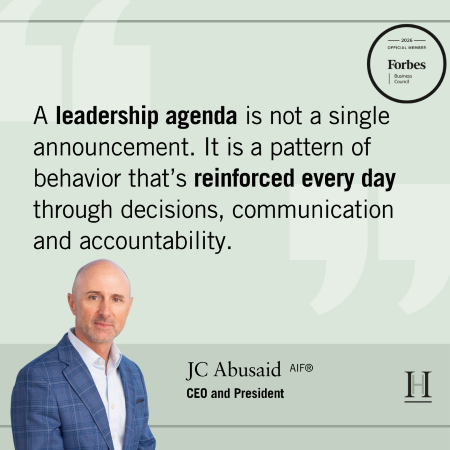
A leadership agenda is not a single announcement. It is a pattern of behavior that’s reinforced every day through decisions, communication and accountability. When culture is real, ownership is clear, and leaders balance conviction with adaptability, the agenda becomes visible.
It becomes how the organization operates.