By Expert Panel®, Forbes Councils Member, for Forbes Business Council, featuring JC Abusaid, CEO/President
When a C-suite leader leaves, the impact can extend beyond the executive team, potentially affecting everything from company culture to business momentum. The incoming executive must navigate established relationships, shifting priorities and new expectations while the organization works to maintain stability through the change.
A thoughtful leadership transition can ease uncertainty, maintain confidence and give the new leader a strong foundation for success. Below, members of Forbes Business Council share practical steps organizations can take to help incoming executives settle into their roles smoothly while keeping the business on track.
Key Takeaways
-
How organizations can prepare incoming executives by gathering employee feedback and identifying potential challenges.
-
Why structured handovers and access to institutional knowledge help maintain business momentum.
-
How mentorship, stakeholder conversations, and listening sessions can help new leaders build relationships and understand company culture.
-
Why clearly defined responsibilities, expectations, and early priorities create stability during leadership changes.
-
How organizations can prepare for leadership transitions by reducing dependence on any one executive.
1. Ask Employees Which Missteps To Avoid
Tell your new executives what to avoid. Encourage them to speak with employees and ask about three things they should never do as leaders. Common themes will likely emerge, revealing sensitive relationships, topics or practices they should approach with caution. People are often more forthcoming about red lines. – Mehul Nagrani, Intergrate
2. Build Internal Support Before Day One
Sponsorship is everything when you have a new C-suite leader. We have a lengthy interview process with many participants. I make sure to give the participants opportunities to speak about what they have learned about the new leader during the interview process. Even before they start, people are excited to welcome them on board because their peers have endorsed them. – Ellen Grantham, TruTechnologies, Inc.
3. Structure The Handover Of Key Priorities
Establish a structured handover process that gives the incoming executive a clear understanding of the company’s priorities, ongoing initiatives and key challenges. Make sure they have direct access to key stakeholders and the context behind major decisions. This helps preserve institutional knowledge, maintain momentum and avoid unnecessary disruptions during the transition. – Raman Varma, Kestrel AI
4. Clarify Expectations And Provide Essential Access
Provide the new executive with clarity from day one. Give them time to assess the current landscape so they understand what needs to happen. Make them feel valued and confident. Define expectations, responsibilities, success and challenges while respecting their decision-making authority. Provide access to the right people, tools and information so they can assess the landscape, make informed decisions and ensure a stable transition. – Roshawnda Allen, SAWTST, LLC
5. Explain The Company’s History
6. Give The New Leader Time To Listen
Make the transition a compassionate journey. Respect what has been achieved in the past and carry it forward. The incoming leader should pause, listen, digest and implement the strategies expected of the role in the best interests of the organization. This will help them maintain good-faith relationships while the transition is happening. Mutual care and respect will reflect the culture of a holistic working environment. – Ramesh Arora, Grand Metropolitan Hotels-Signature Hotels Group
7. Explain The Reasoning Behind Past Decisions
Give the new leader context before giving them the wheel. They need to understand why key decisions were made, where the pressure points are, and who the people are who keep things moving. A strong handoff gives them room to lead their own way without having to learn everything through trial and error. – Henry Pershin, BusinessCapital.com
8. Practice Operating Without A C-Suite Leader
One of the best ways to prepare for a leadership transition is to practice operating without that leader before you have to. Parental leave, sabbaticals and other absences can serve as valuable trial runs. We use those moments intentionally so we are better prepared when a permanent transition happens. We have built the muscle to keep operating smoothly without depending too heavily on any one person—even a C-suite leader. – Sara Mauskopf, Winnie
9. Keep Everyone Focused On The Company’s Mission
Keep unapologetically moving the mission forward—that is what unites the entire organization, from seasoned staff to new leaders. Make sure team members are comfortable in their defined roles, performing their jobs as usual. While a new executive will bring freshness to the team, the ultimate reason they are joining the company is to support and advance the mission. – Jackie (Ott) Jaakola, EveryCat Health Foundation
10. Arrange Candid Stakeholder Conversations
Give the new executive an honest read on the room before day one. Set up candid conversations with key team members, top clients and the board so they hear what’s working, what’s fragile and what’s unspoken. Pair that with a clear message to the team about what won’t change. Stability comes from knowing where the landmines are. – Manit Kaushal, UPI Study
11. Schedule Listening Sessions Across Teams
Pair the new leader with a trusted internal mentor and schedule listening sessions with diverse teams to build rapport. This builds relationships, accelerates cultural understanding and signals stability as well as support from trusted existing leadership within the organization. When executives start with genuine connection and curiosity, the team feels continuity and confidence—not just change. – Jen Fuller, PA Consulting
12. Connect The Executive With Employees And Customers
Onboarding is only the start. Embed the new executive in the culture by giving them real time with employees, customers and key stakeholders before expecting major decisions. In my EIA framework, “Embed” comes before “Interpret” and “Act” for a reason. Stability comes from understanding what people value and what’s already working before deciding what should change. – Muraly Srinarayanathas, Computek College
13. Provide Mentorship And An Early Roadmap
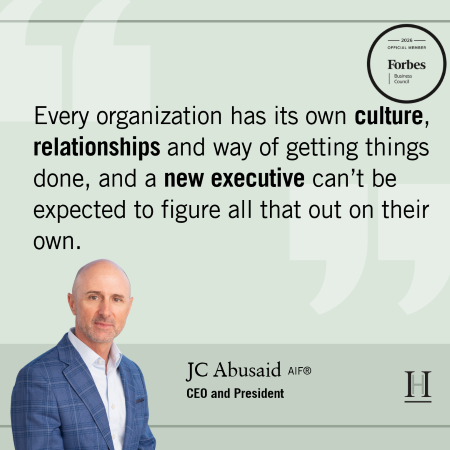
Mentorship is the biggest aspect. Every organization has its own culture, relationships and way of getting things done, and a new executive can’t be expected to figure all that out on their own. Having a designated mentor, a clear roadmap for the first several months, and well-defined measures of success helps create clarity and confidence early on. – John Abusaid, Halbert Hargrove
14. Explain Informal Networks And Cultural Norms
Do not just hand them the org chart; hand them the unwritten rules. Every organization runs on informal networks, unspoken expectations and cultural norms that no onboarding document captures. The fastest way to stabilize a transition is to pair the new leader with someone who knows how things actually work, not just how they are supposed to. Context accelerates credibility. – Shawn Galloway, ProAct Safety, Inc.
15. Publicly Affirm The New Executive’s Authority
The organization must immediately transfer full executive authority to the new leader without forcing them to operate in the shadow of their predecessor. Do not make them navigate old anchors. Publicly validate their vision and allow them to make immediate, strategic decisions. When the team sees that the new leader has clearance to execute, it eliminates anxiety and stabilizes momentum. – Reco McCambry, Novae
16. Protect The First 90 Days For Learning
Give the new executive a protected first 90 days to learn before changing anything. In medicine, we take a full history before we treat, and leadership deserves the same discipline. Pair them with a peer who knows where the unwritten rules live, and agree on two or three early measures together. Stability comes from understanding the system first, not from fast moves made to prove a point. – Ana Baroni, Longevity Tech Fund
17. Define The Role And Its Early Priorities
Define the seat before the person sits in it. Clarify exactly what the role owns, who it reports to, and what success looks like in the first 90 days, then give the new leader a few clear priorities. Ambiguity is what erodes culture during transitions. Clarity lets a new executive earn trust fast. – Shelly Sun Berkowitz, Founder 2 Founder
18. Reassign The Departing Leader’s Responsibilities
Protect continuity before announcing change. Identify the relationships, decisions and cultural responsibilities that depend too heavily on the departing leader, then assign clear ownership. People can handle leadership change; what damages momentum is uncertainty about who is responsible for what afterward. – Farida Abjani, Aging Gracefully Home Health
19. Allow The New Executive To Question Past Decisions
I’d give the new executive permission to question the decisions made before they arrived. Too often, people expect a new leader to carry on as though nothing has changed. That’s unfair to them and the business. Be clear about what must stay in place, but give them room to lead. Otherwise, you’ve hired someone new and asked them to be the person who left. – Peter Doyle, Consult Group Worldwide (CGW)